


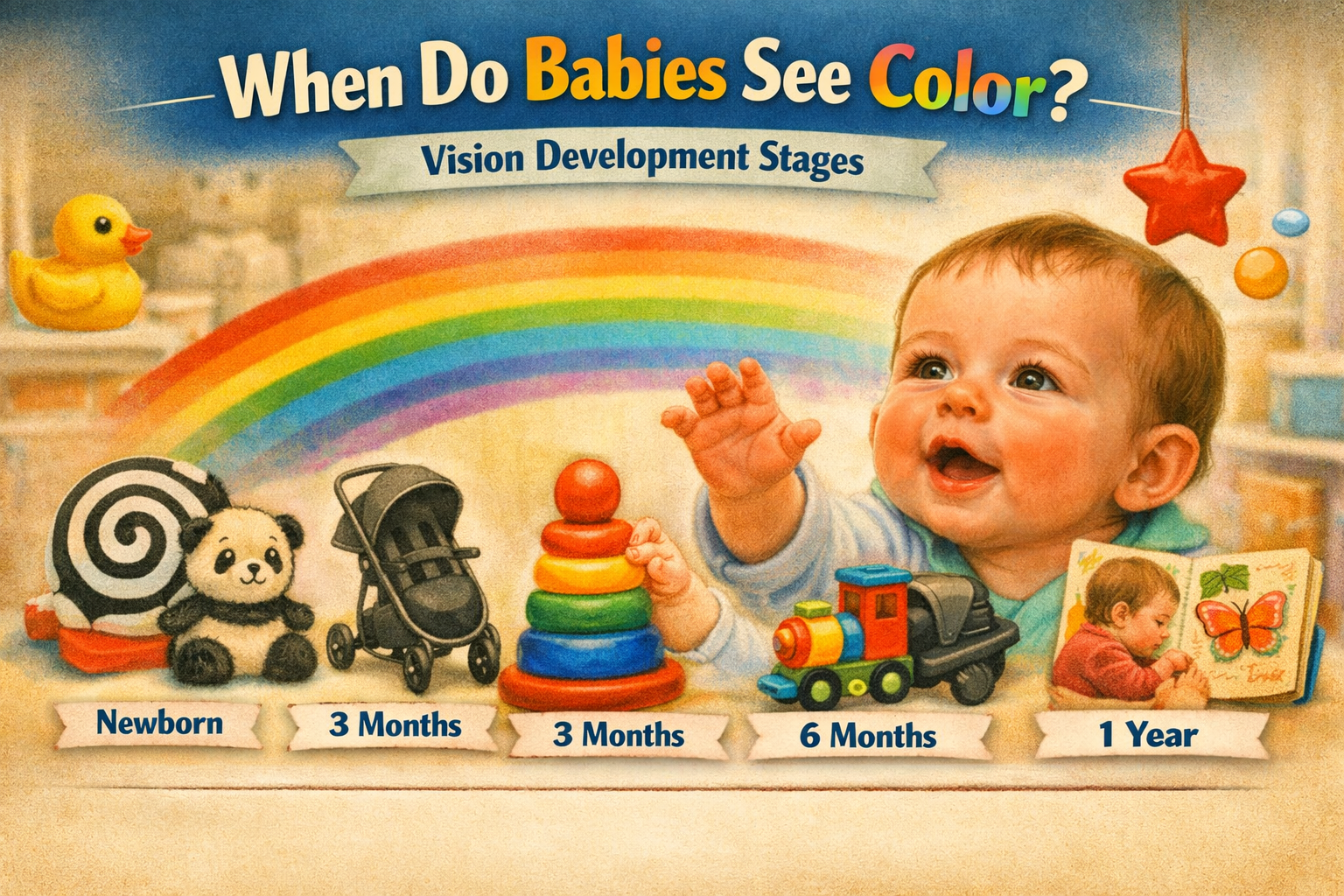
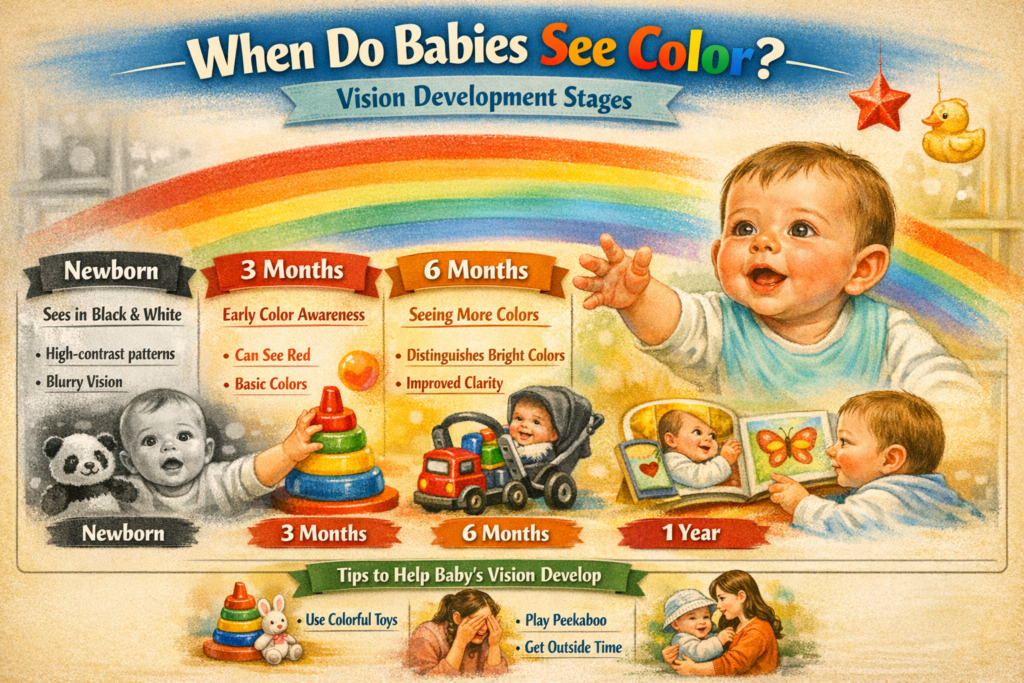
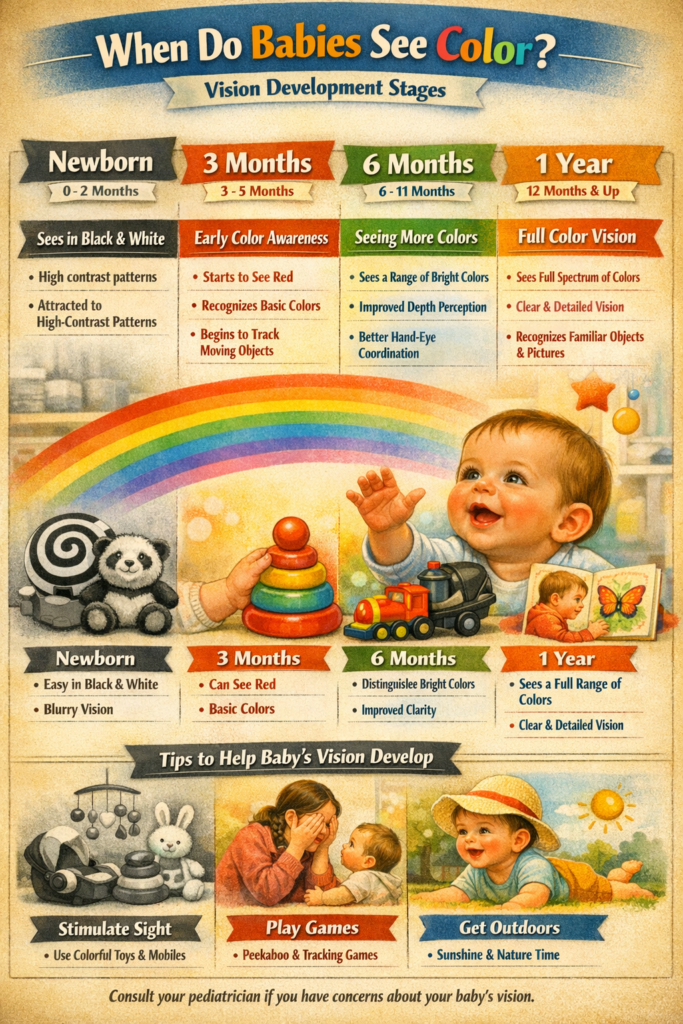
Babies begin to see their first colors, primarily bright red, around two to three months of age. At birth, newborns only see in black, white, and shades of gray because the color-detecting cells in their retinas are not fully developed. By five months, an infant’s color vision matures significantly, allowing them to distinguish between subtle hues and see the full spectrum of colors much like an adult.
A Guide to Infant Vision Development
Watching a baby open their eyes to the world is a profound experience for any new parent. Yet, the world they are looking at is vastly different from the one you see. While adults experience their surroundings in a rich, vibrant tapestry of high-definition color, a newborn’s visual experience is surprisingly limited, blurry, and devoid of the rainbow.
Understanding exactly how and when infants develop color vision offers incredible insight into their cognitive growth. It explains why they stare blankly at certain beautifully painted nursery walls but become utterly captivated by a simple black-and-white patterned book. The journey from seeing blurry shadows to identifying bright, distinct colors is a complex neurological marvel.
Let’s break down the biological mechanics of newborn eyesight, explore the precise timeline of color vision development, and uncover actionable ways you can support your child’s visual milestones.
The Fascinating World of Newborn Eyesight
To understand when color enters a baby’s world, we first have to understand the biological hardware they are working with at birth. Vision is arguably the least developed of all the senses when a child is born. While hearing has been fine-tuned during the third trimester of pregnancy, the eyes have been resting in the dark, watery environment of the womb, entirely unexposed to light and complex visual stimuli.
The Anatomy of Developing Eyes: Rods vs. Cones
Human vision relies on two primary types of photoreceptor cells located in the retina, the light-sensitive tissue lining the back of the eye. These cells are known as rods and cones.
Rods are responsible for vision at low light levels. They do not mediate color vision, but they are highly sensitive to motion and shape. At birth, a baby’s rods are relatively well-developed, which is why they can detect the difference between light and dark, such as a bright window in a dimly lit room.
Cones, on the other hand, are the cells that process color and fine detail. Humans possess three types of cones, each sensitive to a different wavelength of light: red, green, and blue. When a baby is born, these cone cells are incredibly immature. They lack the structural integrity and the neurological pathways required to send color signals to the brain. Because the brain cannot yet interpret these signals, a newborn’s world is rendered entirely in grayscale.
What Do Babies See at Birth?
Imagine looking through a heavily frosted piece of glass, smeared with a thin layer of Vaseline, and you have a rough approximation of newborn eyesight. A baby’s visual acuity at birth is estimated to be around 20/400.
Their focal length is fixed at approximately 8 to 12 inches away from their face. From an evolutionary standpoint, this is a brilliant design. Eight to twelve inches is exactly the distance between a mother’s face and the baby’s face during feeding. The infant’s visual world is intentionally narrowed to focus on the most critical element of their survival: their caregiver. Anything beyond that tight focal radius fades into an indistinct, blurry gray background.
Month-by-Month Vision Development Stages
The progression of infant vision is rapid. Within the first six months of life, the visual cortex of the brain undergoes explosive growth, building billions of synapses that allow the eyes and the brain to communicate with increasing speed and clarity.
0 to 1 Month: The High-Contrast Era
During the first few weeks of life, a baby’s eyes are still learning how to work together. You might frequently notice their eyes crossing or wandering independently. This is a normal part of building the extraocular muscles.
Because they cannot process color, they are drawn exclusively to high-contrast patterns. Black and white stripes, concentric circles, and bold checkerboards are incredibly stimulating to a newborn. These stark differences in light and dark send the strongest possible visual signals to their developing retinas. A pale pink teddy bear will blend into the background, but a black-and-white flashcard will capture and hold their attention, helping them practice visual fixation.
2 to 3 Months: The Arrival of Red and Green
This is the turning point in the visual journey. Around the two-month mark, the cone cells in the retina begin to mature rapidly. The first color receptor to come online is typically the one sensitive to long-wavelength light: red.
Suddenly, a bright red toy or a crimson shirt will catch your baby’s eye in a way it couldn’t just a few weeks prior. Shortly after red, the cones responsible for detecting green begin to function. During this stage, babies also start developing the ability to track moving objects smoothly across their field of vision without moving their entire head, a skill known as smooth pursuit.
4 to 5 Months: The Full Spectrum Unlocks
By four to five months, the visual cortex has matured enough to process signals from all three types of cone cells. Your baby can now see blue and yellow, completing their primary color palette.
Not only can they see these colors, but they also begin to differentiate between subtle shades and pastel hues. While a three-month-old might only notice bold primary red, a five-month-old can begin to tell the difference between red, orange, and pink.
This is also the stage where binocular vision firmly takes root. The brain learns to combine the visual input from both the left and right eyes to create a single 3D image. This neurological leap gives the baby true depth perception, fundamentally changing how they interact with their environment.
6 to 8 Months: Clarity and Coordination
By the half-year mark, your baby’s visual acuity has sharpened remarkably, approaching the 20/20 vision of an adult. They can recognize people and objects from across a large room. Their color vision is fully realized, and they use this vibrant new world to guide their rapidly developing motor skills.
As they begin to reach, grasp, and eventually crawl, their improved depth perception allows them to judge distances accurately. They can see a brightly colored toy, understand exactly how far away it is, and coordinate their hands to grab it.
How to Stimulate Your Baby’s Visual Development
Parents play a crucial role in fostering visual growth. Just as you talk to your baby to encourage language development, providing the right visual stimuli encourages the optic nerve and brain pathways to strengthen.
The Power of High-Contrast Toys
In the early weeks, ditch the pastels. Your newborn will benefit immensely from bold, graphic patterns. Using high-contrast flashcards during tummy time is an excellent way to encourage them to lift their head and build neck strength.
As you curate your nursery, consider investing in developmentally appropriate infant gear that features removable black-and-white elements. Mobiles with geometric black-and-white shapes hung 10 to 12 inches above the crib can provide critical visual exercise during those brief periods of quiet alertness.
Introducing Color Strategically
As your baby approaches the three-month mark, begin introducing primary colors. Red is always the best starting point. A bright red rattle or a vividly colored crinkle book will immediately capture their newly acquired color-detecting cones.
Avoid overwhelming them with chaotic, multi-colored environments right away. Focus on introducing one or two bold colors against a neutral background. As they master reaching and grabbing, you can offer a wider variety of textured, vividly colored toys to simultaneously stimulate their tactile and visual senses.
Finding the right balance of gear designed specifically for these developmental stages can feel overwhelming, but connecting with resources within the Wobblebee parenting community can help you discover products backed by pediatric research.
Signs of Visual Milestones and When to Worry
While every child develops at their own unique pace, there are distinct visual milestones you should look for during the first year. Monitoring these milestones helps ensure that the communication between the eyes and the brain is progressing normally.
Tracking Normal Eye Alignment
It is entirely normal for a newborn’s eyes to occasionally cross or drift outward during the first two months. Their eye muscles are weak and uncoordinated. However, by three to four months of age, their eyes should be straight and aligned most of the time. They should be able to focus on your face and track a slow-moving object smoothly from side to side.
Red Flags to Discuss with Your Pediatrician
While minor deviations in the timeline are normal, certain signs warrant a prompt evaluation by a pediatric ophthalmologist. You should consult your doctor if you notice any of the following:
- Constant Eye Crossing: If one or both eyes constantly turn in (strabismus) or out after four months of age.
- Lack of Tracking: If your baby does not follow a moving object with their eyes by three months.
- No Eye Contact: If your baby fails to make steady eye contact with caregivers by two months.
- White Pupil: If the pupil of the eye appears white or cloudy instead of black (this can be a sign of congenital cataracts or other serious conditions).
- Extreme Light Sensitivity: If your baby seems severely distressed or excessively tears up in normal lighting conditions.
The Connection Between Vision and Motor Skills
Vision does not develop in a vacuum; it is deeply intertwined with a child’s physical development. The ability to see color and judge depth is the catalyst for almost all gross and fine motor milestones in the first year.
Hand-Eye Coordination Takes Flight
Before a baby can grasp an object, they must first fixate on it visually. Once depth perception emerges around five months, you will witness a massive leap in hand-eye coordination. The baby uses their matured color vision to spot an interesting object, their depth perception to calculate the distance, and their motor cortex to command the arm to reach out.
Providing a safe environment filled with visually engaging, stimulating play mats and sensory items gives your child the motivation they need to practice these complex, multi-system skills.
Visual Milestones by Age: A Quick Reference
Use the table below to track your baby’s visual progression through the first year.
| Age Range | Color Vision Status | Key Visual Milestones | Best Visual Stimulation |
| 0 – 1 Month | Black, white, and gray only. | Focuses 8-12 inches away; brief eye contact. | Black-and-white high-contrast patterns; faces. |
| 2 – 3 Months | Red and green emerge. | Smoothly tracks moving objects; eye crossing resolves. | Bright red and green primary-colored toys. |
| 4 – 5 Months | Full color spectrum (blue/yellow). | Depth perception begins; hand-eye coordination improves. | Multi-colored toys; mirrors; reaching exercises. |
| 6 – 8 Months | Mature color vision. | Visual acuity approaches adult levels; recognizes distant faces. | Complex, colorful picture books; interactive sensory toys. |
| 9 – 12 Months | Fully developed. | Excellent depth perception aiding crawling and walking. | Stacking blocks; colorful shape sorters. |
As you watch your baby grow from a sleepy newborn into an active, curious toddler, their expanding visual world is the engine driving their exploration. By understanding when they see color and how their eyesight evolves, you can better appreciate the massive neurological hurdles they are overcoming every single day.
Frequently Asked Questions
Do babies see upside down when they are born?
Yes, technically the physical lens of a newborn’s eye projects images onto the retina upside down. However, the infant’s rapidly developing brain quickly learns to process and invert these signals, allowing them to perceive the world right-side up within the first few days of life.
Can newborns recognize their parents’ faces?
Newborns are highly drawn to the contrast of human faces, particularly the hairline and eyes. While they cannot see fine details clearly, they can recognize the general shape and outline of their primary caregivers’ faces when held 8 to 12 inches away.
Why do my baby’s eyes sometimes cross?
In the first two months, a baby’s extraocular muscles (the muscles controlling eye movement) are weak and still learning to coordinate. Occasional crossing or wandering is completely normal, but if the eyes remain constantly crossed after four months, you should consult a pediatrician.
What colors are most calming for a baby?
Once a baby develops full color vision around five months, muted, cool tones like soft blues, greens, and pale lavenders are generally the most soothing. These colors have lower light wavelengths and are less stimulating to the visual cortex than bright reds or oranges, making them ideal for a nursery environment.
When should my baby have their first eye exam?
Pediatricians perform basic eye screenings during all routine well-child visits starting at birth to check for structural issues and light reflexes. A more comprehensive eye exam by a pediatric eye doctor is typically recommended between 6 and 12 months of age to ensure normal alignment and visual development.