


Baby-led weaning (BLW) is an approach to introducing solid foods where infants self-feed manageable pieces of whole foods rather than being spoon-fed purees. Starting around six months of age, babies sit with the family and are offered finger-sized sticks of soft, nutrient-dense foods. This method fosters independence, improves fine motor skills, and encourages intuitive eating by allowing the baby to control their own intake.
For decades, the standard milestone for a baby reaching six months of age was the introduction of watery rice cereal and perfectly smooth, spoon-fed purees. Parents were tasked with “getting the food into the baby,” often relying on airplane noises and sneaky spoonfuls to ensure their infant ate the required amount.
Today, pediatric nutrition has experienced a massive paradigm shift. Instead of passive recipients of food, babies are being encouraged to become active participants in their own culinary journey. Baby-led weaning has skyrocketed in popularity, praised by pediatricians, occupational therapists, and dietitians alike for its profound developmental benefits.
However, handing a six-month-old infant a spear of roasted broccoli can feel incredibly intimidating for a first-time parent. Understanding the mechanics, safety protocols, and developmental milestones associated with this method is essential for a stress-free transition from milk to family meals. Let’s explore exactly what baby-led weaning entails, how to know when your child is ready, and how to execute this method safely and confidently.
What is Baby-Led Weaning (BLW)?
Coined by British health visitor and midwife Gill Rapley in the early 2000s, baby-led weaning is a philosophy that completely bypasses the traditional puree stage. The term “weaning” in this context refers to the British definition (adding complementary foods to an infant’s diet) rather than the American definition (ceasing breast milk or formula).
At its core, BLW operates on a profound trust in the infant’s biological capabilities. You provide safe, appropriately sized, and nutritious foods, and the baby decides what, how much, and how fast to eat.
By removing the spoon and the purees, the baby is forced to use their hands to grasp the food, bring it to their mouth, chew (even with no teeth), and swallow. They learn about the true texture, color, and flavor of individual ingredients, rather than experiencing food as a homogenous, blended paste.
Traditional Spoon-Feeding vs. Baby-Led Weaning
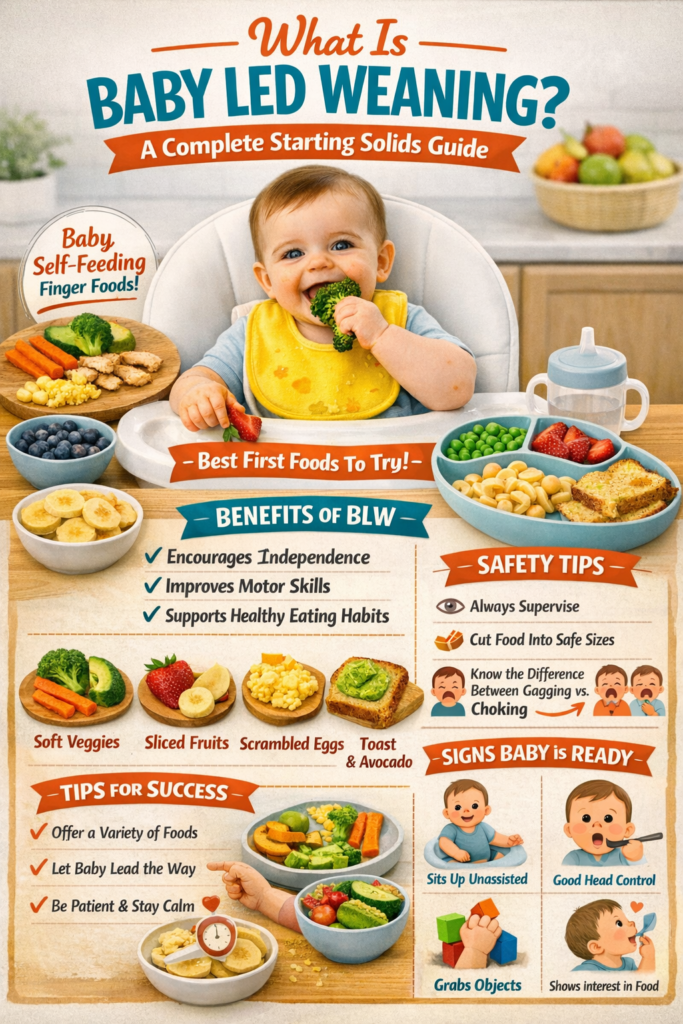
To fully understand the BLW philosophy, it is helpful to see how it contrasts with the traditional method of starting solids.
| Feature | Traditional Spoon-Feeding | Baby-Led Weaning (BLW) |
| Feeding Mechanism | Caregiver controls the spoon and pace. | Baby self-feeds using their own hands. |
| Food Texture | Thin purees, progressing to thick mashes, then chunks. | Soft, whole foods served in stick or spear shapes. |
| Oral Motor Skill Focus | Primarily swallowing; chewing is learned much later. | Immediate practice of biting, chewing, and moving food with the tongue. |
| Fine Motor Skill Focus | Minimal infant involvement. | Heavy focus on grasping, hand-eye coordination, and reaching. |
| Mealtime Dynamic | Baby is fed separately or requires dedicated parental focus. | Baby eats independently alongside the family at the same time. |
Signs of Readiness: When Can You Start?
One of the most critical aspects of baby-led weaning is timing. Because BLW requires the baby to sit upright and independently manage solid pieces of food, it cannot be rushed. You should never start baby-led weaning before the age of six months.
Age alone, however, is not the only indicator. Your baby must exhibit specific physiological and developmental milestones to ensure they can eat whole foods safely.
1. Independent Sitting and Head Control
Your baby must be able to sit completely unassisted in their high chair with strong, stable neck control. If they are slouching, slumping to the side, or their head is bobbing, they do not have the core strength required to protect their airway while swallowing. Proper posture is the foundation of safe eating.
2. Loss of the Tongue-Thrust Reflex
Infants are born with a protective tongue-thrust reflex (extrusion reflex), which causes them to automatically push foreign objects out of their mouth with their tongue to prevent choking. This reflex naturally fades between four and six months of age. If you place a piece of food in your baby’s mouth and they immediately thrust it back out, they are not quite ready.
3. Advanced Hand-Eye Coordination
A baby must possess the motor skills to look at a piece of food, successfully grasp it with their hand, and bring it directly to their mouth in one fluid motion.
4. Active Interest in Food
Your baby should be actively watching you eat, tracking your fork from your plate to your mouth, and perhaps even reaching out to try and grab food from your plate during family dinners.
The Incredible Benefits of Baby-Led Weaning
Why go through the massive mess of letting a six-month-old feed themselves? The benefits extend far beyond simply getting calories into their body; BLW is a full-sensory developmental exercise.
Promoting Intuitive Eating and Appetite Control
When a caregiver spoon-feeds a baby, it is very easy to accidentally overfeed them. The parent’s goal is often to “finish the jar.” In BLW, the infant is entirely in control. They eat until they are full and then they simply stop. This fosters a lifelong foundation of intuitive eating, teaching the child to listen to their own internal hunger and fullness cues rather than external pressure.
Advanced Fine Motor Skill Development
Every meal is an intensive occupational therapy session. In the beginning, babies use a rudimentary “palmar grasp,” raking food into their fists. As they practice over the weeks, they refine their movements, eventually mastering the “pincer grasp” (using the thumb and index finger to pick up tiny objects like a single pea).
To support this physical development, you need the right environment. Investing in ergonomic high chairs and silicone feeding sets ensures your baby is sitting at the correct 90-degree angle with a stable footrest, giving them the core support they need to focus entirely on their hand movements.
Expanding the Palate and Preventing Picky Eating
Purees often mask the true taste of vegetables by blending them with sweet fruits like apples or pears. With BLW, a piece of roasted zucchini tastes and feels exactly like roasted zucchini. Exposing babies to a massive variety of distinct textures, colors, and flavors early on has been clinically shown to reduce the likelihood of severe picky eating during the toddler years.
Safety First: Choking vs. Gagging
The number one hesitation parents have regarding baby-led weaning is the fear of choking. It is a completely valid fear, but it is often rooted in a misunderstanding of the infant anatomy and the difference between gagging and choking.
The Protective Power of the Gag Reflex
Gagging is a normal, safe, and highly expected part of learning to eat. In a six-month-old infant, the gag reflex is triggered much further forward on the tongue than it is in an adult. This is an evolutionary safety mechanism. If a piece of food is too big or travels too far back before it is properly chewed, the sensitive gag reflex triggers immediately. The baby will turn red, make loud coughing or retching sounds, their eyes may water, and they will physically push the food forward and out of their mouth.
While terrifying to watch, gagging means the baby’s safety system is working perfectly. You should not intervene, panic, or stick your fingers in their mouth, as this can accidentally push the food further back into their airway. Stay calm, watch them, and let them work it out.
Recognizing True Choking
Choking, conversely, is a medical emergency. Choking occurs when a piece of food completely blocks the airway.
Choking is silent. The baby will not be coughing or making noise because air cannot pass through their vocal cords. They may turn blue or pale and look terrified.
To prevent choking, you must prepare food correctly and ensure the baby is always seated upright and fully supervised. It is highly recommended that all parents and caregivers take an infant CPR and choking rescue class before starting solids.
How to Prepare First Foods for BLW
The success and safety of BLW hinge entirely on how the food is prepared and presented. At six months, babies do not have a pincer grasp, so they cannot pick up small, bite-sized cubes.
The “Pinky Finger” Rule
For a six-to-eight-month-old, food should be cut into long, thick strips or wedges that are roughly the size and length of an adult’s pinky finger. This allows the baby to grasp the bottom of the food in their fist while the top half protrudes from their hand, allowing them to easily bring it to their mouth and bite off pieces with their gums.
The “Smush” Test
Food must be soft enough for a toothless baby to mash with their strong gums. If you can easily smush the piece of food between your thumb and index finger using gentle pressure, it is safe for the baby.
Excellent Starter Foods
When building your baby’s first plates, focus on nutrient density, specifically incorporating iron and healthy fats, which are crucial for infant brain development.
- Avocado wedges (leave a strip of skin on the bottom half for a better grip).
- Steamed broccoli florets (the stalk acts as a perfect natural handle).
- Roasted sweet potato wedges.
- Banana (cut in half, with some of the peel left on the bottom to prevent it from slipping out of their hands).
- Strips of tender, slow-cooked beef or chicken thigh.
- Thickly scrambled egg strips.
Dangerous Foods to Strictly Avoid
Certain shapes and textures pose a severe choking risk and should not be offered to infants under any circumstances:
- Round, firm foods: Whole grapes, cherry tomatoes, whole berries, and hot dog rounds (these must be quartered lengthwise).
- Hard, crunchy foods: Raw apples, raw carrots, whole nuts, popcorn, and hard candies.
- Sticky foods: Large globs of peanut butter or sticky marshmallows.
- Honey: Strictly prohibited for babies under one year of age due to the risk of infant botulism.
Embracing the Mess and Moving Forward
Let’s be honest: baby-led weaning is incredibly messy. Your floor, your high chair, and your baby’s hair will be covered in avocado and oatmeal. This mess is not a side effect; it is a feature of the sensory learning process. They are learning about gravity, temperature, and viscosity.
To preserve your sanity, invest in high-quality, durable, easy-to-clean baby feeding supplies like full-coverage smock bibs, silicone catch-all mats, and suction plates that prevent the entire meal from being thrown onto the floor.
Remember that before the age of one, breast milk or formula remains your baby’s primary source of nutrition. Solid foods are simply for practice, exploration, and palate development. If your baby spends an entire meal just squishing a banana through their fingers and licking it off their hands, that is a wildly successful meal.
For more tips, recipe ideas, and a supportive network of parents navigating the exact same messy milestones, the Wobblebee parenting community provides excellent resources and shared experiences to help you confidently guide your child’s culinary journey.
Frequently Asked Questions
When should I start baby-led weaning?
You should start baby-led weaning when your infant is at least six months old and showing all the vital signs of readiness. This includes sitting up completely unassisted, having full head and neck control, and losing the tongue-thrust reflex.
What is the difference between choking and gagging?
Gagging is a loud, noisy, and safe reflex where the baby coughs and sputters to push food forward; it requires no intervention. Choking is completely silent, as the airway is blocked, and requires immediate emergency first aid (back blows).
Can I combine purees and baby-led weaning?
Yes, this is often called the “combo method.” You can offer loaded spoons of purees or mashed foods (like oatmeal or yogurt) and hand the spoon to the baby to feed themselves, while simultaneously offering stick-shaped whole foods on their tray.
Do babies need teeth for baby-led weaning?
No, babies do not need teeth to start eating solid foods. Infant gums are incredibly hard and powerful, and they are fully capable of mashing soft-cooked fruits, vegetables, and tender meats without a single tooth in their mouth.
What are the best first foods for BLW?
The best first foods are soft, nutrient-dense, and easy to hold. Great options include thick wedges of ripe avocado, steamed sweet potato spears, broccoli florets, and strips of softly cooked egg or tender meats to provide essential iron.