


Babies are born with kneecaps, but they are made entirely of soft cartilage rather than solid bone. This flexible cartilage allows infants to crawl comfortably and absorb the physical impact of learning to walk. The cartilage slowly undergoes ossification, fusing into the hard bony patella you recognize, typically completing this process between the ages of three and five years old.
Holding a newborn is a delicate experience. They feel incredibly fragile, soft, and remarkably pliable. This physical squishiness is not just an illusion; it is a fascinating biological adaptation designed to ensure their safe arrival into the world and their rapid growth during the first few years of life.
One of the most persistent and surprising rumors about infant anatomy is that babies are born without kneecaps. When you run your hand over a baby’s knee, you will not feel the familiar, hard, bony lump of a patella. This leads many parents to panic or assume their child’s skeletal system is somehow incomplete.
The truth about your baby’s knees, and their skeletal structure as a whole, is a marvel of evolutionary engineering. Let’s break down the science behind infant kneecaps, explore the incredible process of bone ossification, and uncover the most astonishing facts about your child’s developing skeletal system.
The Truth About Baby Kneecaps
To answer the question directly: yes, babies have kneecaps. However, they are fundamentally different in composition from the kneecaps of an adult or even an older child.
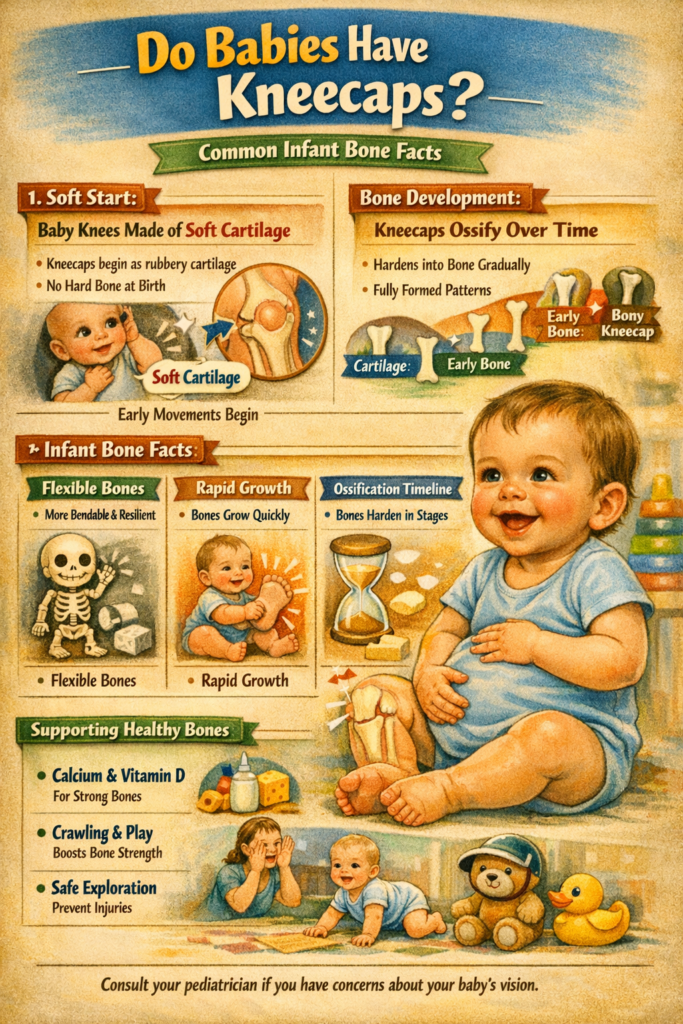
At birth, the kneecap (medically known as the patella) is formed entirely of cartilage. Cartilage is a firm, flexible connective tissue. It is the same material that gives structure to your ears and the tip of your nose. Because it is not yet calcified bone, it does not show up on standard X-rays, which is precisely how the myth that “babies have no kneecaps” originated decades ago before the advent of modern MRI and ultrasound imaging.
The Evolutionary Purpose of Soft Knees
Nature operates with incredible intention. There are two primary, vital reasons why your baby is equipped with cartilaginous knees rather than hard, bony ones.
First, the birthing process requires intense physical flexibility. If a baby were born with a fully rigid, ossified skeleton, navigating the narrow birth canal would be near impossible and highly dangerous for both the mother and the infant. Soft, pliable cartilage allows the baby’s limbs to fold and compress safely during delivery.
Second, consider the intense physical trauma of infancy and toddlerhood. Learning to move is a contact sport. Babies spend months dragging their knees across carpets, hardwood floors, and tiles as they master the art of crawling. If their kneecaps were made of hard bone, the friction and impact would be incredibly painful and could cause severe bruising or micro-fractures. The thick pad of cartilage acts as a built-in biological shock absorber, allowing them to slam their knees into the floor with wild abandon while feeling zero pain.
How Infant Bones Grow: The Ossification Process
The transformation of a squishy newborn into a sturdy, running toddler is driven by a biological process called ossification. This is the mechanism by which soft cartilage is gradually replaced by hard bone.
The Timeline of Bone Hardening
Ossification does not happen overnight. It is a slow, methodical process that begins in the womb and continues well into late adolescence.
In the case of the patella, the cartilage continues to grow and expand as the baby gets bigger. Around the time your child turns three years old, a tiny center of bone—known as an ossification center—begins to form in the middle of the cartilage mass.
Over the next several years, specialized cells called osteoblasts deposit calcium and other essential minerals onto this framework, slowly expanding the bony area outward. By the time a child is roughly five or six years old, the cartilage has been almost entirely replaced by the hard, bony kneecap that will last them the rest of their life.
Fascinating Facts About Your Baby’s Skeleton
The kneecap is just one small piece of the puzzle. An infant’s skeletal system operates under a completely different set of rules compared to an adult’s.
Babies Are Born With More Bones Than Adults
This is perhaps the most mind-boggling fact of human anatomy: your tiny baby has more bones than you do.
A human adult has exactly 206 bones. A newborn baby, however, arrives with approximately 300 distinct bones and cartilage elements. How does a growing human lose nearly 100 bones? They don’t disappear; they fuse.
Much of a newborn’s skeleton is segmented, separated by wide bands of cartilage. As the child grows and the ossification process takes over, these separate fragments slowly knit together to form single, larger bones. The most prominent examples of this fusion occur in the skull and the spine. The sacrum, the large triangular bone at the base of your spine, is actually made up of five distinct vertebrae at birth that fuse together as you reach adulthood.
The Magic of the Soft Spots (Fontanelles)
If you have ever gently stroked a newborn’s head, you have likely noticed the soft, pulsating spots where there appears to be no skull. These are the fontanelles.
An infant’s skull is not a single, solid dome. It is comprised of several different bony plates held together by flexible, fibrous joints called sutures. The intersections where these plates meet are the fontanelles. The two most prominent are the anterior fontanelle (on the top of the head) and the posterior fontanelle (at the back of the head).
These gaps serve two critical functions:
- Cranial Compression: They allow the skull plates to actually overlap each other during birth, temporarily reducing the circumference of the head to pass safely through the birth canal.
- Rapid Brain Growth: A baby’s brain grows at an astonishing rate during the first year of life. If the skull were fully fused at birth, the brain would have no room to expand. The flexible fontanelles provide the necessary space for massive neurological development.
The smaller posterior fontanelle typically closes by the time the baby is two to three months old. The larger anterior fontanelle takes much longer, usually closing completely between 9 and 18 months of age.
The Flexibility Factor
Because of the high ratio of cartilage to bone, babies are essentially little contortionists. They can chew on their own toes, sleep in impossibly folded positions, and bounce back from tumbles that would leave an adult bedridden. This extreme flexibility is a protective mechanism, safeguarding their internal organs and joints while they lack the muscular strength to protect themselves.
Supporting Healthy Bone Development
While genetics heavily dictate your child’s physical growth, environmental factors and daily care play a massive role in building a strong skeletal foundation.
Nutrition for Strong Bones
Calcium and Vitamin D are the undisputed champions of bone health.
- Vitamin D: This vitamin is essential because it allows the body to absorb calcium. Breast milk is notoriously low in Vitamin D, which is why pediatricians globally recommend Vitamin D supplement drops for exclusively breastfed infants starting in the first few days of life. Formula-fed infants generally get enough Vitamin D from their fortified formula.
- Calcium: During the first six months, your baby gets all the calcium they need from breast milk or formula. As you introduce solid foods, incorporating calcium-rich options like full-fat yogurt, cheese, and leafy green purees is crucial for fueling the ongoing ossification process.
Safe Physical Activity and Tummy Time
Bones grow stronger when they are used. Physical resistance prompts the body to build denser bone tissue.
For an infant, “exercise” looks like tummy time. Pushing up against gravity builds the critical bone density and muscle mass in their neck, shoulders, and spine. When setting up your nursery with premium baby care essentials, prioritizing a safe, engaging floor space is vital. Finding the right supportive infant play mats gives your baby the traction and cushioning they need to practice rolling, pivoting, and eventually crawling without slipping.
Encourage free movement rather than keeping your baby confined to bouncers or swings for extended periods. The more they move, the stronger their skeletal frame becomes. If you are looking for more actionable advice on setting up your home for active infant development, the resources available through the Wobblebee parenting network offer excellent, expert-backed guidance.
Infant Skeletal Development: Cartilage vs. Bone
Understanding the difference between the two primary materials in your baby’s body helps clarify their developmental milestones. Use this table as a quick reference.
| Feature | Infant Cartilage | Mature Bone |
| Texture & Flexibility | Soft, rubbery, highly pliable. | Hard, rigid, unbending. |
| Primary Function in Infants | Shock absorption, growth framing, passing through birth canal. | Structural support, organ protection, anchoring muscles. |
| Visibility on Standard X-Ray | Invisible (appears as a gap). | Highly visible (solid white). |
| Key Locations in Newborns | Kneecaps, wrists, ankles, ends of long bones, skull sutures. | Centers of long bones (femur, humerus), ribs, central skull plates. |
| Developmental Trajectory | Slowly calcifies and hardens over years. | Becomes denser and thicker with physical activity and nutrition. |
Watching your child grow from a fragile newborn into a sturdy, active toddler is a remarkable journey. By understanding the invisible, complex biological processes happening beneath the surface—from cartilage kneecaps to fusing skull plates—you can better appreciate the absolute miracle of human development.
Frequently Asked Questions
What age do babies get hard kneecaps?
The process of ossification—where the soft cartilage of the kneecap begins turning into hard bone—typically starts around three years of age. The kneecap usually finishes fusing into a completely solid bone by the time the child is five or six years old.
Why do babies have 300 bones?
Infants are born with roughly 300 bones and cartilage elements to allow for extreme flexibility during childbirth and rapid growth in infancy. As the child grows, many of these separate cartilaginous segments fuse together to form the 206 solid bones found in the adult human skeleton.
Does crawling hurt a baby’s knees?
No, crawling does not hurt a baby’s knees. Because their kneecaps are made of thick, squishy cartilage rather than solid bone, the cartilage acts as a natural shock absorber, protecting them from the friction and impact of crawling on hard floors.
When do a baby’s soft spots close?
A baby has two primary soft spots, or fontanelles. The smaller posterior fontanelle at the back of the head typically closes between two and three months of age. The larger anterior fontanelle on top of the head usually closes between 9 and 18 months of age.
How can I help my baby’s bones grow strong?
Ensuring your baby gets adequate Vitamin D (often via drops for breastfed babies) is essential for calcium absorption. Additionally, encouraging daily physical activity, such as supervised tummy time, provides the physical resistance necessary to build strong, dense bones.