


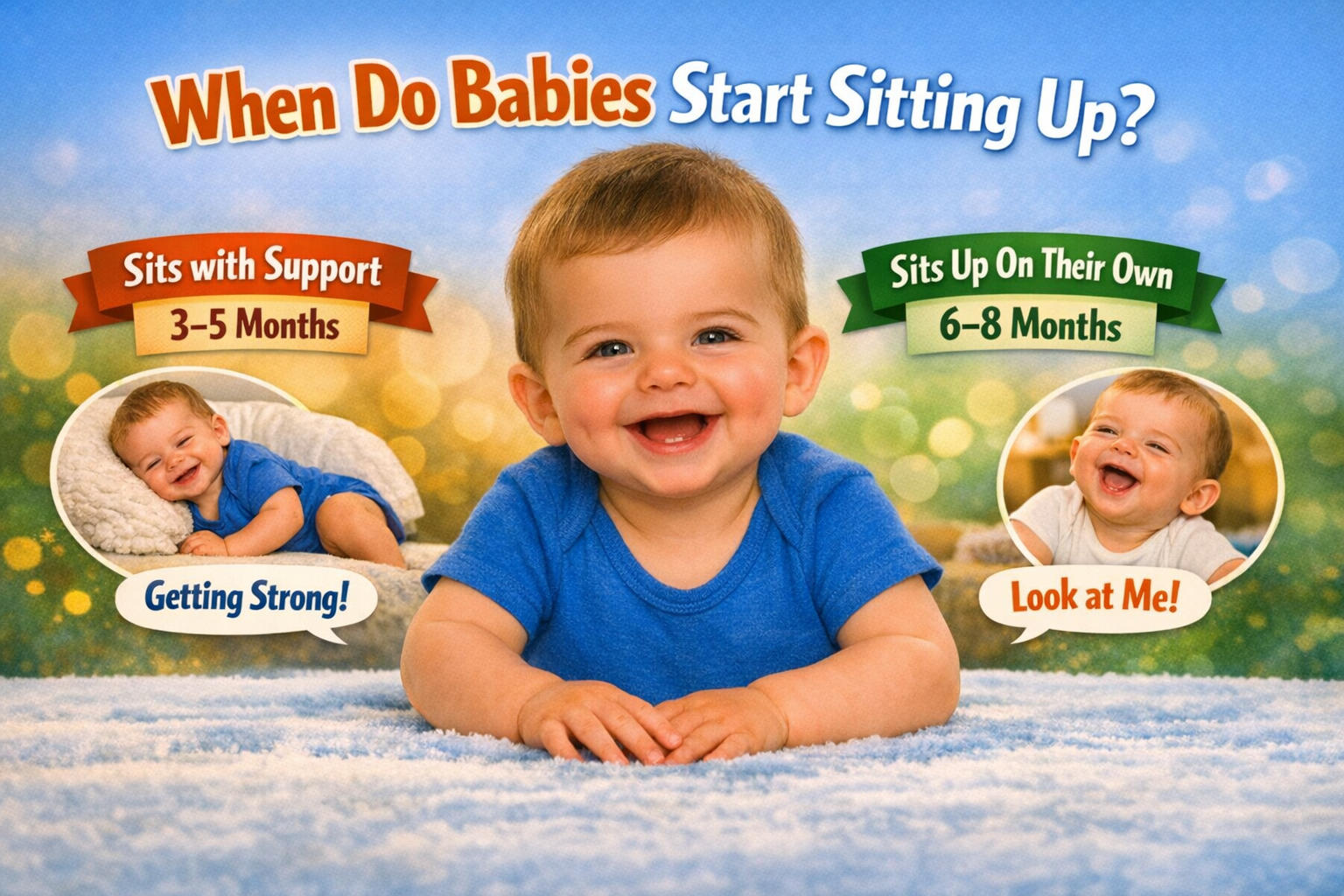
🪑 When Do Babies Start Sitting Up & Sit Up on Their Own?
Watching your baby learn to sit up is one of the most exciting milestones — it marks the transition from lying down to exploring the world upright. Sitting up helps strengthen muscles, improve balance, and prepare for crawling and walking.

📊 Sitting‑Up Timeline
| Age Range | Milestone | Description |
|---|---|---|
| 0–3 months | Head control begins | Baby lifts head briefly during tummy time. |
| 3–5 months | Assisted sitting | Baby can sit with support (like a caregiver’s hands or a pillow). |
| 5–6 months | Tripod sitting | Baby leans forward on hands for balance. |
| 6–8 months | Independent sitting | Baby can sit without support for short periods. |
| 8–9 months | Stable sitting | Baby sits confidently and can reach for toys without falling. |
Fun fact: Most babies sit up independently around 6 months, but some may take until 8–9 months — both are perfectly normal.
💪 Why Sitting Up Matters
- Core strength: Builds muscles needed for crawling and walking.
- Balance and coordination: Helps baby learn to control posture.
- Fine motor skills: Sitting frees hands for play and exploration.
- Social interaction: Sitting allows eye‑level engagement with caregivers.
🧠 Signs Your Baby Is Ready to Sit Up
- Holds head steady when upright.
- Rolls over both ways.
- Pushes up on arms during tummy time.
- Shows curiosity by reaching for toys.
These signs usually appear between 4–6 months, signaling that your baby’s muscles are ready for the next step.
👶 How to Encourage Sitting
- Tummy time: Strengthens neck, shoulders, and back.
- Supported sitting: Use your lap or a firm pillow behind baby.
- Playtime: Place toys slightly out of reach to motivate movement.
- Avoid prolonged use of baby seats: They can restrict muscle development.
- Celebrate progress: Every wobble and topple builds balance!
⚠️ When to Talk to a Doctor
Consult your pediatrician if:
- Your baby isn’t sitting with support by 6 months.
- Your baby isn’t sitting independently by 9 months.
- There’s poor head control or limited movement.
Early evaluation helps rule out muscle tone or developmental delays.
❓ FAQs
Q: When do babies sit up without support? A: Most babies sit independently between 6–8 months.
Q: Is it okay to use a baby seat or Bumbo chair? A: Occasionally, yes — but avoid long periods. Natural movement builds strength better.
Q: Can tummy time help my baby sit sooner? A: Absolutely. It’s one of the best exercises for developing the muscles needed for sitting.
Q: What if my baby skips sitting and goes straight to crawling? A: Some do! Every baby’s development is unique. As long as other milestones are met, it’s fine.
Q: Should I prop my baby up with pillows? A: Yes, for short periods — but always supervise to prevent falls.
Q: When do babies start pulling themselves into a sitting position? A: Around 8–9 months, once they’ve mastered balance and core strength.
Q: Does early sitting mean faster walking? A: Not necessarily. Each milestone builds different skills; walking depends on leg strength and coordination.