


When Do Babies Start Crawling?
Crawling is one of the most exciting milestones in a baby’s development. It marks the beginning of greater independence and exploration. Parents often wonder when their little one will start moving around on their own, and the answer can vary widely.
🍼 Typical Age Range
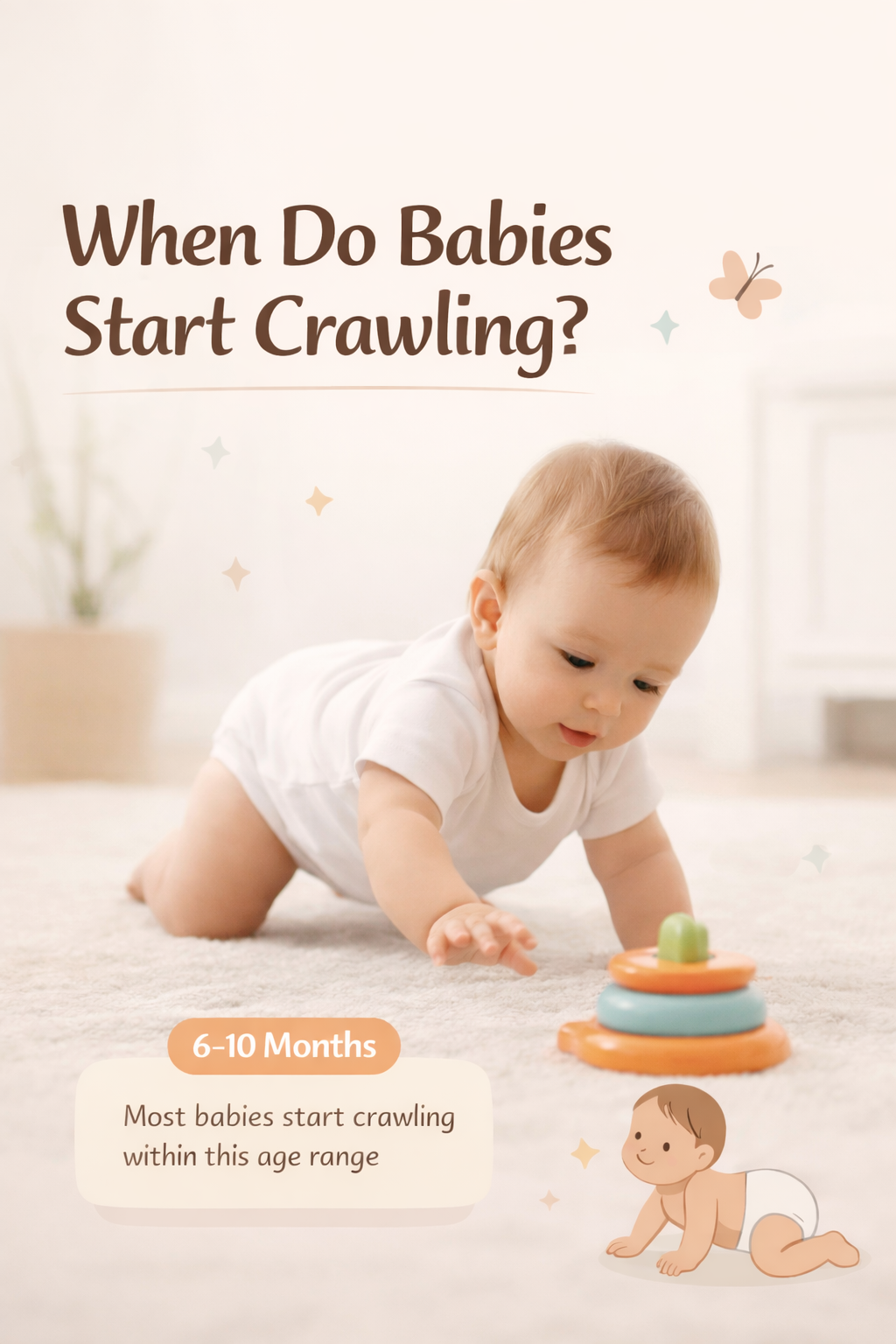
Most babies begin crawling between 6 to 10 months, but there is a wide variation. Some may start earlier, while others skip crawling altogether and move straight to pulling up and walking.
📊 Crawling Age Milestones Table
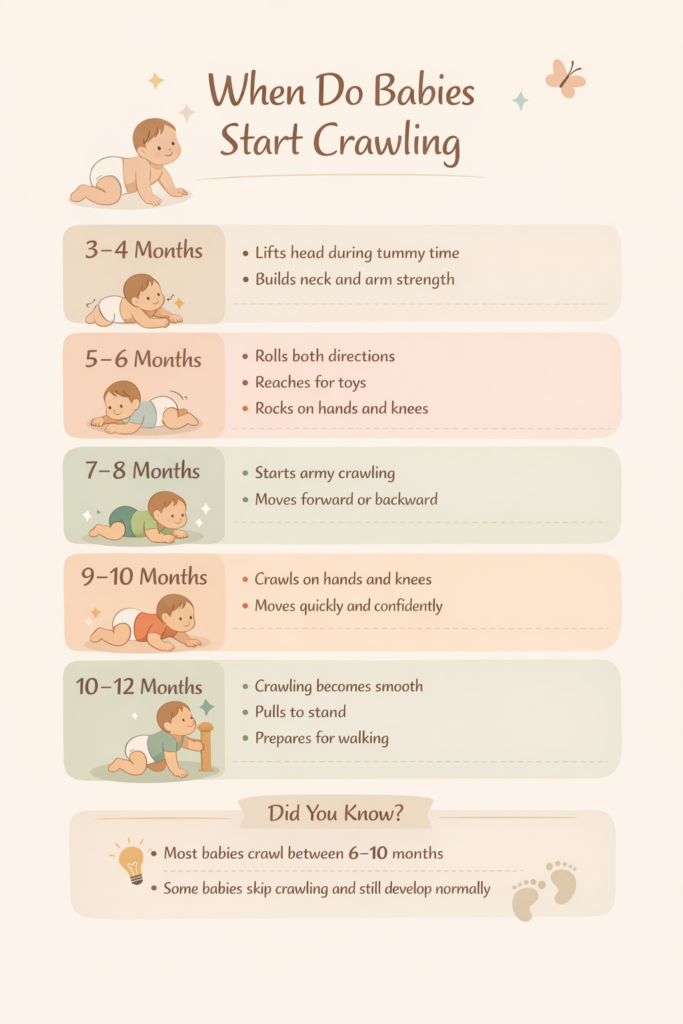
| Age (Months) | Developmental Signs | Crawling Possibility |
|---|---|---|
| 4–5 | Rolling over, pushing up on arms | Too early, but building strength |
| 6–7 | Sitting without support, rocking on hands and knees | Early crawling may begin |
| 8–9 | Scooting, army crawling, classic crawl | Most babies start crawling |
| 10–11 | Bear crawl, crab crawl, pulling up | Advanced crawling styles |
| 12+ | Walking attempts, skipping crawl | Some babies bypass crawling |
Most babies start crawling between 6 and 10 months.
- Some begin as early as 5 months
- Others take their time and start closer to 10 to 12 months
- A few skip crawling and move straight to walking
According to the Centers for Disease Control and Prevention, crawling often appears as a developmental milestone around 9 months, though timing varies.
The American Academy of Pediatrics also explains that development happens at different speeds, and variation is normal.
👉 One simple takeaway
Every baby follows their own timeline, and crawling is not a strict deadline.
Real Stats From Research
Here is what large-scale child development data shows:
- Around 50% of babies crawl by 8 months
- About 75% crawl by 10 months
- Nearly 90% show some form of mobility by 12 months
(Source: pediatric developmental studies summarized by the World Health Organization)
Another interesting fact
About 10 to 15% of babies skip traditional crawling and still develop normally.
Signs Your Baby Is Ready to Crawl

Before crawling starts, babies show small signals.
Key readiness signs
- Strong neck and head control
- Pushing up during tummy time
- Rolling from tummy to back and back to tummy
- Rocking on hands and knees
- Trying to move forward or backward
👉 These signs usually appear around 4 to 7 months
Different Types of Crawling

Not all babies crawl the same way.
Common crawling styles
- Classic crawl
Hands and knees moving alternately - Army crawl
Sliding on the tummy using arms - Bear crawl
Moving with straight arms and legs - Scooting
Sitting and dragging forward
👉 All styles are normal as long as the baby is moving and developing strength.
Why Crawling Is Important
Crawling supports more than movement.
Development benefits
- Builds muscle strength
- Improves coordination and balance
- Supports brain development and spatial awareness
- Helps with future skills like walking and writing
The American Academy of Pediatrics highlights that early movement builds connections between the brain and body.
How To Help Your Baby Start Crawling

You can gently support development with simple daily activities.
Easy tips that work
- Give daily tummy time
- Place toys slightly out of reach
- Encourage floor play instead of long stroller time
- Create a safe, open space
- Limit time in walkers or seats
👉 Consistency matters more than intensity
When To Be Concerned
Every baby grows differently, but some delays need attention.
Speak to a pediatrician if
- No movement attempts by 10 to 12 months
- Difficulty holding head up
- Very stiff or very floppy muscles
- No interest in moving
Early support helps improve outcomes.
Common Questions Parents Ask
Q: Do all babies crawl A: No. Some babies skip crawling and move straight to standing or walking.
Q Is early crawling betterA Not necessarily. Development quality matters more than speed.
Q Does crawling affect intelligence A Crawling supports brain development, but it does not directly determine intelligence.
- Q: What developmental benefits does crawling provide? A: Crawling builds muscle strength, coordination, and supports brain development by connecting both hemispheres. It also improves spatial awareness and prepares babies for future skills like walking and climbing.
- Q: How can I make my home safe once my baby starts crawling? A: Baby-proofing is essential. Cover electrical outlets, secure furniture, remove choking hazards, and block stairways with gates to create a safe exploration space.
- Q: Do cultural practices affect crawling milestones? A: Yes. In some cultures, parents encourage walking earlier, so crawling may be less emphasized. This variation is normal and doesn’t indicate a problem.
- Q: When should I be concerned if my baby isn’t crawling? A: If your baby shows no mobility attempts (rolling, scooting, or crawling) by 12 months, or has very stiff/floppy muscles, consult a pediatrician.
- Q: How does crawling transition into walking? A: Crawling often leads to pulling up, cruising along furniture, and eventually walking. Each stage builds strength and balance for the next milestone.
- Q: Is skipping crawling harmful? A: Not necessarily. Some babies go straight to walking. As long as they’re developing other motor skills, skipping crawling is usually fine.
Q: What developmental benefits does crawling provide? A: Crawling strengthens muscles, improves coordination, and supports brain development by connecting both hemispheres.
Q: How can I make my home safe once my baby starts crawling? A: Anchor furniture, cover outlets, secure cords, and block stairways with gates to prevent accidents.
Q: Do cultural practices affect crawling milestones? A: Yes. In some cultures, parents encourage walking earlier, so crawling may be less emphasized.
Q: When should I be concerned if my baby isn’t crawling? A: If your baby shows no mobility attempts by 12 months or has stiff/floppy muscles, consult a pediatrician.
Q: How does crawling transition into walking? A: Crawling builds strength and balance, leading to pulling up, cruising along furniture, and eventually walking.
Q: How far can a crawling baby travel? A: At just 1 mph, a baby can cover about 88 feet per minute—proof of why baby-proofing is essential!