

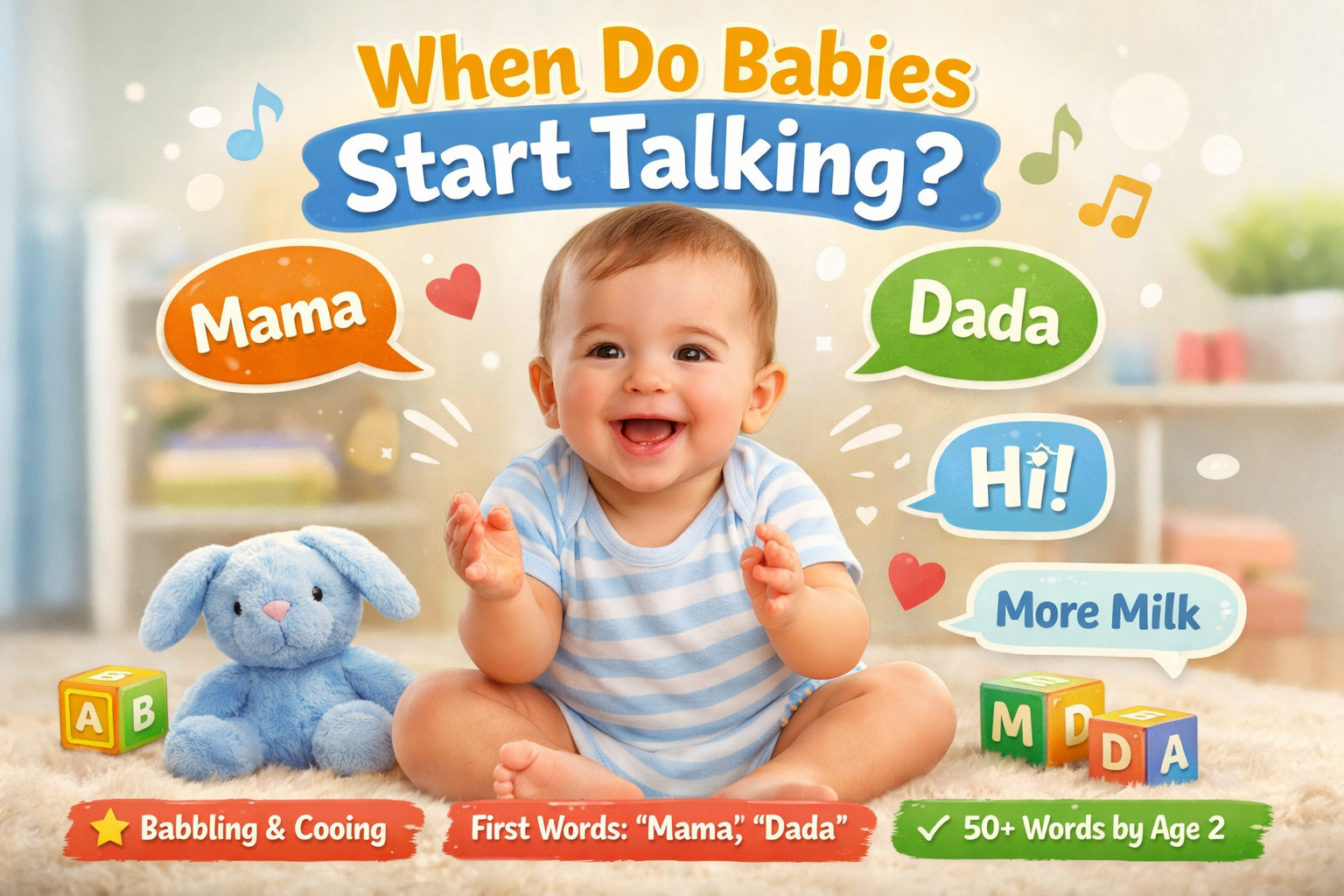
Hearing your baby’s first words is one of the most memorable milestones in parenting. While most babies say “mama” or “dada” around their first birthday, speech development begins much earlier with cooing, babbling, and imitating sounds. Every child’s journey is unique, but research gives us a clear timeline of what to expect.
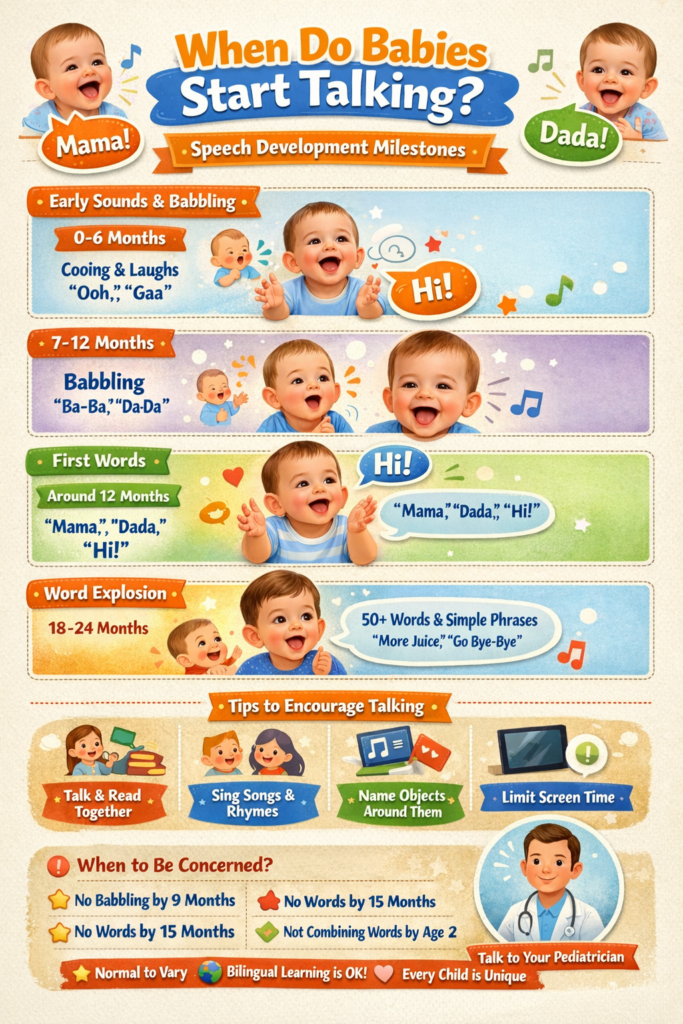
📊 Speech Development Timeline
| Age Range | Typical Milestones | Examples |
|---|---|---|
| Birth–3 months | Cries vary by need, cooing sounds, recognizes caregiver’s voice | “Ooo,” “Ahh” |
| 4–6 months | Babbling begins, responds to tone of voice, enjoys sound-making toys | “Ba-ba,” “Ma-ma” (nonspecific) |
| 7–12 months | Babbling with varied sounds, understands simple words, first real words | “Mama,” “Dada,” “Uh-oh” |
| 12–18 months | Vocabulary grows to 10–15 words, follows simple commands | “Ball,” “Bye-bye” |
| 18–24 months | Uses 50+ words, begins combining two words | “More milk,” “Go car” |
| 2–3 years | Vocabulary expands rapidly, forms short sentences, asks questions | “Where kitty?” “I want cookie” |
| 3–4 years | Uses 4+ word sentences, answers simple questions | “I go park today” |
| 4–5 years | Speaks clearly, tells short stories, understands most conversations | “We went to the zoo” |
Stats: By age 2, most toddlers use 50–100 words and combine them into short phrases. By age 3, vocabulary often exceeds 200 words, with simple sentences forming.
🚼 Signs Your Baby Is Learning to Talk
- Smiles and coos when spoken to (by 3 months).
- Babbling with consonants like b, m, p (by 6 months).
- Responds to their name and simple commands (by 9–12 months).
- Says first words with meaning (around 12 months).
- Vocabulary explosion between 18–24 months.
🌟 How to Encourage Talking
- Talk often: Narrate daily activities (“We’re washing hands”).
- Read books: Point to pictures and name objects.
- Sing songs & rhymes: Rhythm helps language learning.
- Respond to babbling: Repeat sounds back to your baby.
- Limit screen time: Interaction with people is more effective.
🧠 Developmental Benefits of Talking
- Strengthens social bonds with caregivers.
- Builds cognitive skills like memory and problem‑solving.
- Improves emotional expression and self‑confidence.
- Supports future literacy and school readiness.
❓ FAQs
Q: What are the early signs of speech development? A: Babies start with cooing (2–3 months), babbling (6 months), and responding to their name (9 months) before saying first words around 12 months.
Q: How many words should a toddler know by age 2? A: Around 50 words, plus simple two‑word phrases like “more milk” or “go car.”
Q: Does being bilingual delay speech? A: No. Bilingual children may mix languages at first but usually catch up by age 4–5.
Q: When should parents worry about speech delays? A: If your baby doesn’t babble by 9 months, has no words by 15 months, or isn’t combining words by 2 years, consult a pediatrician.
Q: How can parents encourage talking? A: Talk often, read books, sing songs, respond to babbling, and limit screen time.
Q: What’s the difference between speech and language development? A: Speech is making sounds and words, while language includes understanding and using those words to communicate.