


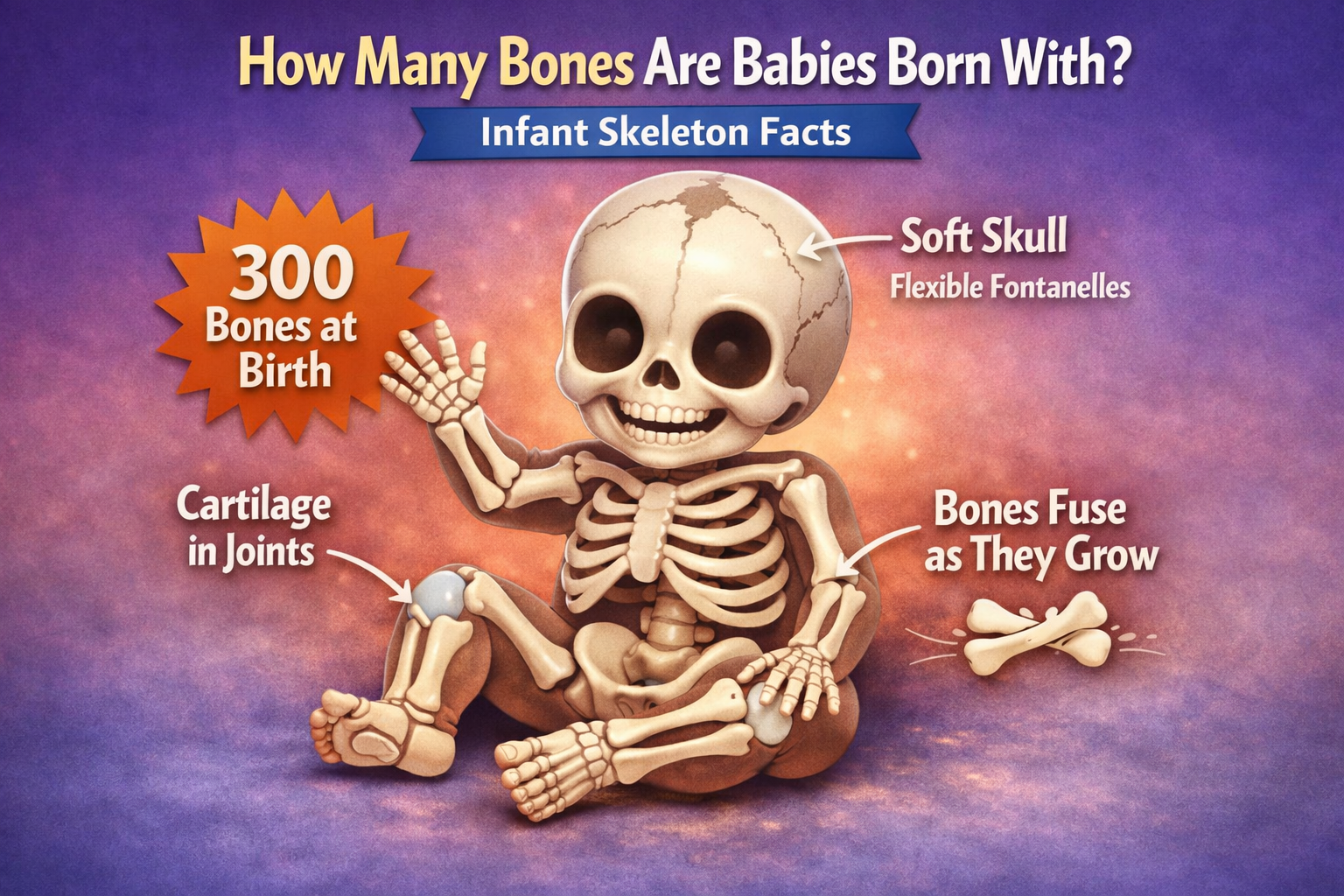
Babies are born with approximately 300 bones, which is nearly 100 more than adult humans. These extra bones are mostly made of flexible cartilage. As a baby grows through childhood and adolescence, many of these smaller cartilage-based bones gradually fuse together in a process called ossification, eventually forming the standard 206 bones of the adult skeleton.
The human body is a marvel of biological engineering, but the newborn body operates on an entirely different set of rules. If you have ever held a newborn, you know they feel incredibly soft, pliable, and delicate. This unique physical state is not just an illusion of their small size; it is a direct result of their skeletal structure.
Understanding the anatomy of an infant explains so much about their physical capabilities, their vulnerability, and the miraculous milestones they achieve in their first year. The journey from 300 soft, cartilage-based bones to a rigid, 206-bone adult skeleton is one of the most dynamic physical transformations a human being will ever undergo.
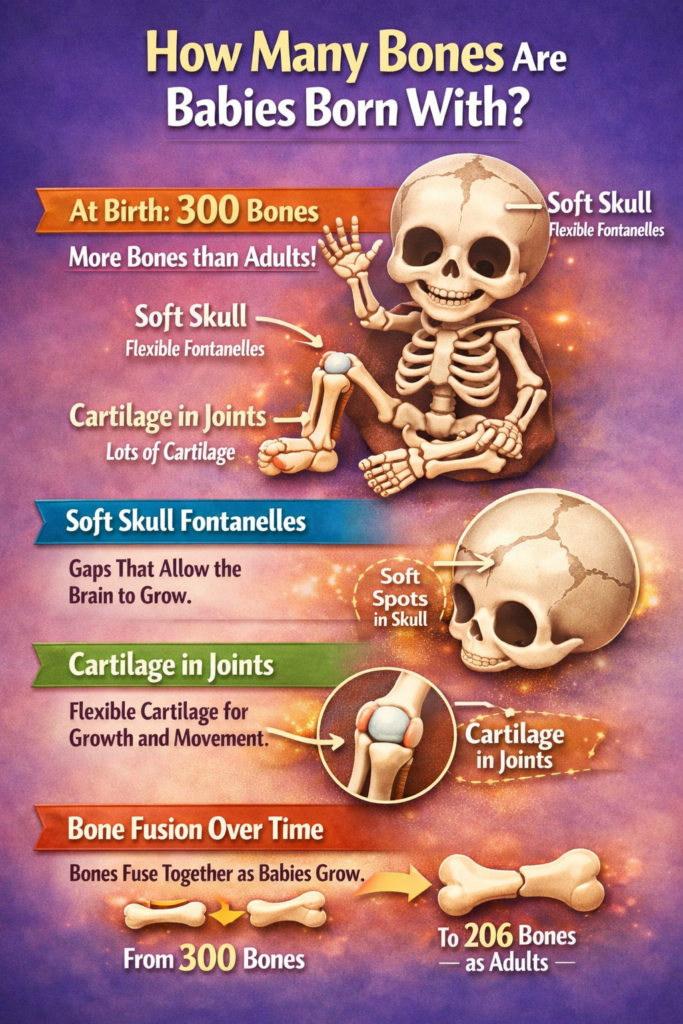
The Magic Number: 300 vs. 206
When we think of a skeleton, we picture hard, calcified structures. However, a baby’s skeleton is largely composed of cartilage—the same firm but flexible tissue that makes up adult ears and noses.
During fetal development in the womb, the foundation of the skeleton is laid down entirely in cartilage. As the pregnancy progresses, a process called endochondral ossification begins. Blood vessels deliver calcium and phosphorus to this cartilage framework, slowly turning it into solid bone.
At birth, this process is far from complete. A newborn emerges with roughly 300 distinct skeletal elements. Over the next two decades, as the child grows, these individual pieces of bone and cartilage will knit together. The “missing” 94 bones do not disappear; they simply merge to form larger, stronger, single bones.
Why Do Babies Need So Many Bones?
Evolution perfectly designed the infant skeleton to survive the immediate challenges of birth and the subsequent demands of rapid physical growth. There are two primary reasons why a baby must have a highly fragmented, flexible skeleton.
1. Navigating the Birth Canal
The human birth canal is narrow, and the human brain is exceptionally large. If a baby’s skeleton were fully calcified and rigid like an adult’s, childbirth would be biologically impossible.
The segmented nature of a baby’s skeleton provides the necessary flexibility to survive the extreme pressure of labor and delivery. The skull, in particular, is designed to physically compress and overlap—a phenomenon known as “molding”—allowing the baby’s head to safely pass through the pelvis.
2. Accommodating Explosive Growth
A baby will double their birth weight by five months and triple it by their first birthday. This explosive growth requires a skeletal framework that can expand rapidly.
Solid, fused bones cannot grow at the pace required by an infant. Instead, babies have “growth plates” (epiphyseal plates) at the ends of their long bones. These areas of active cartilage multiply and eventually calcify, allowing the bones to lengthen before finally sealing shut in late adolescence.
Key Areas of Bone Fusion in Infants
The fusion of the skeleton happens throughout the entire body, but the most dramatic changes occur in a few specific regions.
The Cranium (Skull)
An adult skull is a single, solid structure, but a baby’s skull is composed of several distinct bone plates held together by tough, fibrous membranes called sutures. Where these plates intersect, they form wide gaps known as fontanelles, commonly referred to as “soft spots.”
There are two primary soft spots you can feel on a newborn’s head:
- Anterior Fontanelle: The large, diamond-shaped gap at the top of the head. It usually closes between 12 and 18 months of age.
- Posterior Fontanelle: A smaller, triangular gap at the back of the head, which typically closes within the first two to three months of life.
The Spine and Pelvis
The adult spine consists of 24 vertebrae, plus the sacrum and the coccyx (tailbone). In a newborn, the sacrum is not a single bone; it is made up of five separate vertebrae that will not completely fuse until late adolescence or early adulthood. Similarly, the coccyx begins as four distinct segments.
The pelvis also starts as several separate bones (the ilium, ischium, and pubis) joined by cartilage. As the child begins to walk and bear weight, these sections ossify into the rigid pelvic girdle necessary for upright bipedal movement.
Supporting Bone Health Through Developmental Milestones
As your baby’s bones harden and fuse, their muscles gain the leverage needed to achieve major physical milestones. Tracking these developments gives you a real-time view of their skeletal maturity.
Between birth and 3 months, babies will begin to stretch and kick while lying on their backs, and they will start to raise their head and chest when placed on their stomachs. This requires the neck and upper spine vertebrae to stabilize. They also begin to open and shut their hands, grasping and shaking toys.
As the skeletal framework strengthens between 4 and 7 months, babies learn to roll both ways and can sit with or without the support of their hands. During this stage, they are also able to support their whole weight on their legs when held upright.
By 8 to 12 months, the ossification and muscle coordination have advanced enough that infants can get from a sitting to a crawling position, crawl forward on their bellies, and pull themselves up to stand. Eventually, they will begin walking while holding on to furniture.
To support this rapid physical development, providing the right environment is key. Equipping your home with developmental infant play gear allows your baby to safely practice rolling, sitting, and pulling up, ensuring their growing bones are challenged just enough to build strength without risking injury.
Nutritional Building Blocks for Bone Density
Physical activity must be paired with optimal nutrition. Bone fusion and growth require massive amounts of raw materials.
- Vitamin D: This vitamin is crucial because it allows the body to absorb calcium. Breast milk is notoriously low in Vitamin D, which is why pediatricians globally recommend daily Vitamin D drops for breastfed infants.
- Calcium and Phosphorus: These minerals are the literal building blocks of bone. Whether your baby is receiving breast milk or appropriately mixed infant formula, their primary diet provides the exact calcium ratios required for their skeleton to harden safely.
Infant Skeleton vs. Adult Skeleton Comparison
To visualize just how drastic the changes are from birth to adulthood, use this comparative breakdown of the human skeleton.
| Feature | Infant Skeleton | Adult Skeleton |
| Total Bone Count | Approximately 300 | Exactly 206 |
| Primary Composition | High percentage of flexible cartilage | Dense, calcified, hard bone tissue |
| Skull Structure | Fragmented plates separated by fontanelles (soft spots) | Fully fused, solid cranial vault |
| Spine (Sacrum/Coccyx) | Multiple separate vertebrae | Fused into single sacrum and single coccyx |
| Kneecaps (Patellae) | Made entirely of cartilage (no bone) | Solid, calcified bone |
| Flexibility | Extremely high; designed to absorb impact and compress | Rigid; designed for stability and load-bearing |
As you monitor your child’s growth and curate their living space, utilizing trusted resources like Wobblebee can help you stay informed on best practices. Whether you are looking for nutritional advice or searching for supportive newborn nursery products like firm crib mattresses that protect a baby’s developing spine, understanding their biology makes outfitting your home much easier.
Frequently Asked Questions
Do babies have kneecaps when they are born?
Yes, babies are born with kneecaps, but they are not made of bone. A newborn’s kneecaps (patellae) are made entirely of soft cartilage. This cartilage gradually turns into solid bone between the ages of three and five, which is why toddlers can comfortably crawl on hard floors without experiencing the knee pain an adult would feel.
When do a baby’s soft spots completely close?
A baby has two main soft spots (fontanelles). The smaller one at the back of the head (posterior fontanelle) usually closes by the time the baby is two to three months old. The larger one at the top of the head (anterior fontanelle) takes much longer, typically closing completely between 12 and 18 months of age.
How can I protect my baby’s delicate bones?
Always support your newborn’s head and neck when holding them, as their cervical spine is not yet strong enough to support the weight of their head. Additionally, ensure they sleep on a firm, flat mattress to support their developing spine, and always use an appropriately sized, rear-facing car seat to protect their fragile skeleton during travel.
Can a baby break a bone easily?
Despite having softer bones, babies do not break bones as easily as you might think. Because their bones contain so much cartilage, they are incredibly pliable and tend to bend or bow under pressure rather than snap. When fractures do occur in infants, they are often “greenstick” fractures, where the bone bends and cracks only on one side.
Does a baby’s diet affect how their bones fuse?
Yes. For the cartilage to successfully calcify into solid bone, the body needs an adequate and constant supply of calcium and Vitamin D. A severe deficiency in these nutrients can lead to a condition called rickets, which causes the bones to become excessively soft, weak, and deformed.