



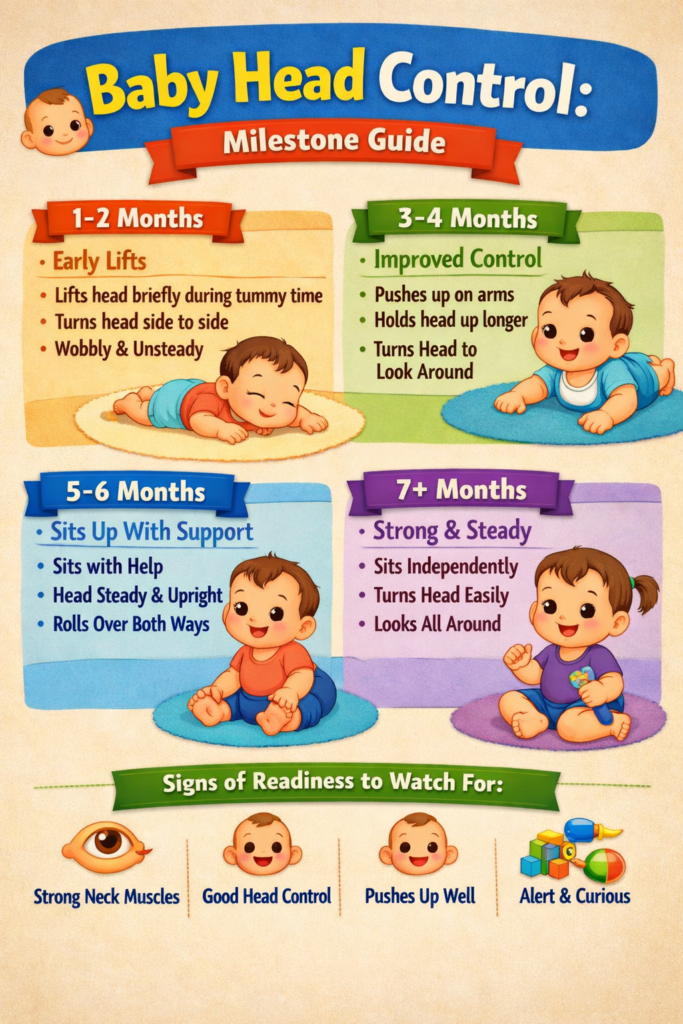
Most babies can briefly lift their head while lying on their stomach during the first month of life. By two to three months, they can hold their head up and steady while resting on their forearms. By four to six months, babies typically develop full, unassisted head and neck control, allowing them to turn their head side-to-side and sit upright with minimal support.
Bringing a newborn home comes with an intense awareness of their physical fragility. The classic “newborn head bobble” is a source of anxiety for nearly every new parent. Because an infant’s head makes up roughly 25% of their total body weight, their underdeveloped neck muscles simply cannot support the load. Supporting the back of their head and neck becomes second nature, dictating how you lift, feed, and pass your baby to family members.
Developing head and neck control is not just a party trick; it is the foundational motor milestone of your baby’s life. It is the prerequisite for every other major physical achievement. Before a baby can roll over, sit up independently, crawl, or eventually walk, they must first master the heavy lifting of their own head. Understanding the biological timeline of this development helps you foster their strength safely while knowing exactly what to look for at your routine pediatric checkups.
The Biology of Infant Motor Development
Human babies are born neurologically immature compared to other mammals. A foal can stand within hours of birth, but a human infant requires months of slow, steady development. This is governed by a principle called cephalocaudal development.
Cephalocaudal development dictates that physical maturity progresses from the top of the body down to the toes. Therefore, the very first voluntary muscle groups a baby learns to control are the ocular (eye) muscles, immediately followed by the cervical (neck) muscles. Once the neck is stable, neurological control moves down the spine to the shoulders, the core (allowing for sitting), the hips (crawling), and finally the legs and feet (walking). If there is a delay in head control, it naturally creates a domino effect, delaying subsequent milestones.
Month-by-Month Head Control Timeline
Every infant develops on their own unique schedule, but medical professionals rely on a highly standardized timeline to track healthy neurological and muscular progression.
Newborn to 1 Month: The Survival Reflexes
At birth, a baby has almost zero independent head control. If pulled into a sitting position, their head will flop completely backward—a condition clinically referred to as “head lag.” However, if placed on their stomach on your chest, survival instincts kick in. Most newborns can lift their head just enough to turn it from side to side to clear their airway. Toward the end of the first month, during supervised floor time, you may notice them lifting their chin briefly off the mat.
2 to 3 Months: The Strengthening Phase
This is when noticeable changes occur. Around the eight-week mark, as their vision improves and they become interested in their environment, babies are highly motivated to look around. When placed on their stomach, a two-month-old should be able to lift their head and chest off the floor, usually at a 45-degree angle. By three months, they will start using their forearms to prop themselves up, holding their head steady for several minutes at a time without aggressively bobbling.
4 to 6 Months: Full Mastery
By four months, the significant head lag seen in newborns should be entirely gone. When you hold your baby upright or pull them from a laying to a sitting position by their arms, their head should stay perfectly in line with their spine. By six months, head control is fully established. They can easily turn their head to track moving objects, tilt it forward to look at their hands, and hold it perfectly steady while sitting in a high chair or stroller.
Milestone Comparison Breakdown
To help you track your baby’s progress, use this guide to evaluate typical physical capabilities versus signs that may warrant a conversation with your pediatrician.
| Age Range | Typical Head Control Milestone | What You Should See During Tummy Time | Red Flags to Mention to Doctor |
| 0-4 Weeks | Minimal control; severe head lag if pulled to sit. | Briefly lifting the chin to turn head side-to-side. | Unable to turn head to clear airway; extreme stiffness. |
| 1-2 Months | Can briefly hold head up when held against a shoulder. | Lifting head and upper chest at a 45-degree angle. | Constant head drooping; no attempt to lift chin. |
| 3-4 Months | Head is mostly steady when held upright; head lag disappearing. | Propping up on forearms; looking forward steadily. | Severe head lag persists; asymmetrical neck posture. |
| 5-6 Months | Full control; head stays perfectly aligned with spine when pulled up. | Pushing up on extended hands; rotating head fully. | Cannot hold head steady while sitting supported. |
How to Encourage Head and Neck Strength
Muscle development requires resistance training. For an infant, gravity provides the resistance, and the floor provides the gym. You do not need to wait for the muscles to develop magically; you must actively facilitate their growth through daily exercises.
The Critical Role of Tummy Time
Tummy time is the single most important activity for a developing infant. Placing a baby on their stomach forces them to work their back, neck, and shoulder muscles against gravity to look around. The American Academy of Pediatrics recommends starting tummy time on the day you bring your baby home from the hospital. Aim for two to three minutes at a time, several times a day, eventually working up to 20 to 30 minutes daily by the time they are two months old.
Many babies absolutely despise tummy time at first because it is physically exhausting work. To mitigate the crying, get down on the floor so they can see your face. As you prepare your dedicated floor space, investing in stimulating infant tummy time mats and developmental toys can transform a frustrating, tear-filled exercise into an engaging sensory experience that distracts them from the physical effort.
Chest-to-Chest Bonding
If your newborn refuses floor-based tummy time, utilize your own body. Recline on a couch or bed at a 45-degree angle and lay your baby face-down on your chest. They will naturally want to lift their head to look at your face and listen to your voice. This counts as highly effective tummy time and is far better tolerated by fussy newborns.
The Football Hold
When carrying your baby around the house, switch up your holding positions. The “football hold”—carrying your baby face-down along the length of your forearm with your hand supporting their chest and chin—forces them to use their neck muscles to look at the passing environment, rather than lazily resting their head against your shoulder.
Evaluating Supportive Gear and Safety
As parents try to manage daily chores, it is incredibly tempting to utilize baby gear. However, the overuse of “containers”—such as swings, bouncers, and car seats—can actively hinder a baby’s physical development.
When a baby is constantly strapped into a semi-reclined bouncer, the hard plastic backing does the physical work of supporting their spine and neck. If they spend hours a day in these devices, they are missing out on crucial floor time, leading to a recognized condition called “container baby syndrome,” characterized by flat spots on the back of the head (plagiocephaly) and delayed motor milestones.
Furthermore, infants without full head control are at risk of positional asphyxiation. If their heavy head slumps forward, their chin can compress their delicate windpipe, cutting off oxygen silently. When upgrading your nursery, selecting safe, ergonomically designed supportive newborn seating essentials ensures your child’s airway remains open during brief, necessary uses. Connecting with the broader parenting community on Wobblebee can help you discover the most current safety guidelines regarding the time limits and proper adjustments for infant gear.
Red Flags: When to Call the Pediatrician
While the timeline has natural variations, consistent delays in head control require medical evaluation to rule out muscular disorders, neurological issues, or vision impairments.
Contact your pediatrician immediately if you observe any of the following:
- Persistent Head Lag: By four months of age, if your baby’s head still flops backward when you gently pull them from a lying to a sitting position by their arms, this is a significant clinical red flag.
- Torticollis (Wryneck): If your baby consistently tilts their head to one specific side and struggles or cries when you try to gently turn it to the other side, they may have a shortened neck muscle requiring physical therapy.
- Loss of Previously Mastered Skills: If a three-month-old baby who was successfully lifting their head suddenly stops doing so and becomes “floppy” (hypotonic), this warrants an emergency medical assessment.
Frequently Asked Questions
Is it normal for my 2-month-old to have a wobbly head?
Yes, it is entirely normal for a two-month-old to have a slightly wobbly head, especially when they are tired or overstimulated. While they are gaining significant strength at this age, they do not yet have the stamina to hold their heavy head perfectly steady for extended periods.
How much tummy time does a 1-month-old need?
A one-month-old should ideally get about 10 to 15 minutes of tummy time per day, broken up into short, manageable sessions. Try laying them on their stomach for just two to three minutes after every diaper change to establish a routine without causing them extreme frustration.
Does holding my baby upright help neck strength?
Holding your baby upright against your chest or shoulder absolutely helps build neck strength. As you move, your baby must make micro-adjustments using their cervical muscles to keep their head balanced, which acts as excellent, low-impact physical therapy.
What happens if a baby doesn’t do tummy time?
Babies who do not get adequate tummy time are at a significantly higher risk for delayed gross motor skills, meaning they will likely roll over, sit, and crawl much later than their peers. They are also highly susceptible to developing plagiocephaly, a permanent flattening of the back of the skull.
Can a newborn sleep with their head up?
No, a newborn should never sleep with their head propped up on a pillow, in an inclined sleeper, or in a car seat outside of a moving vehicle. Until they have full head control, sleeping at an incline drastically increases the risk of their head slumping forward and obstructing their airway.